My Digest
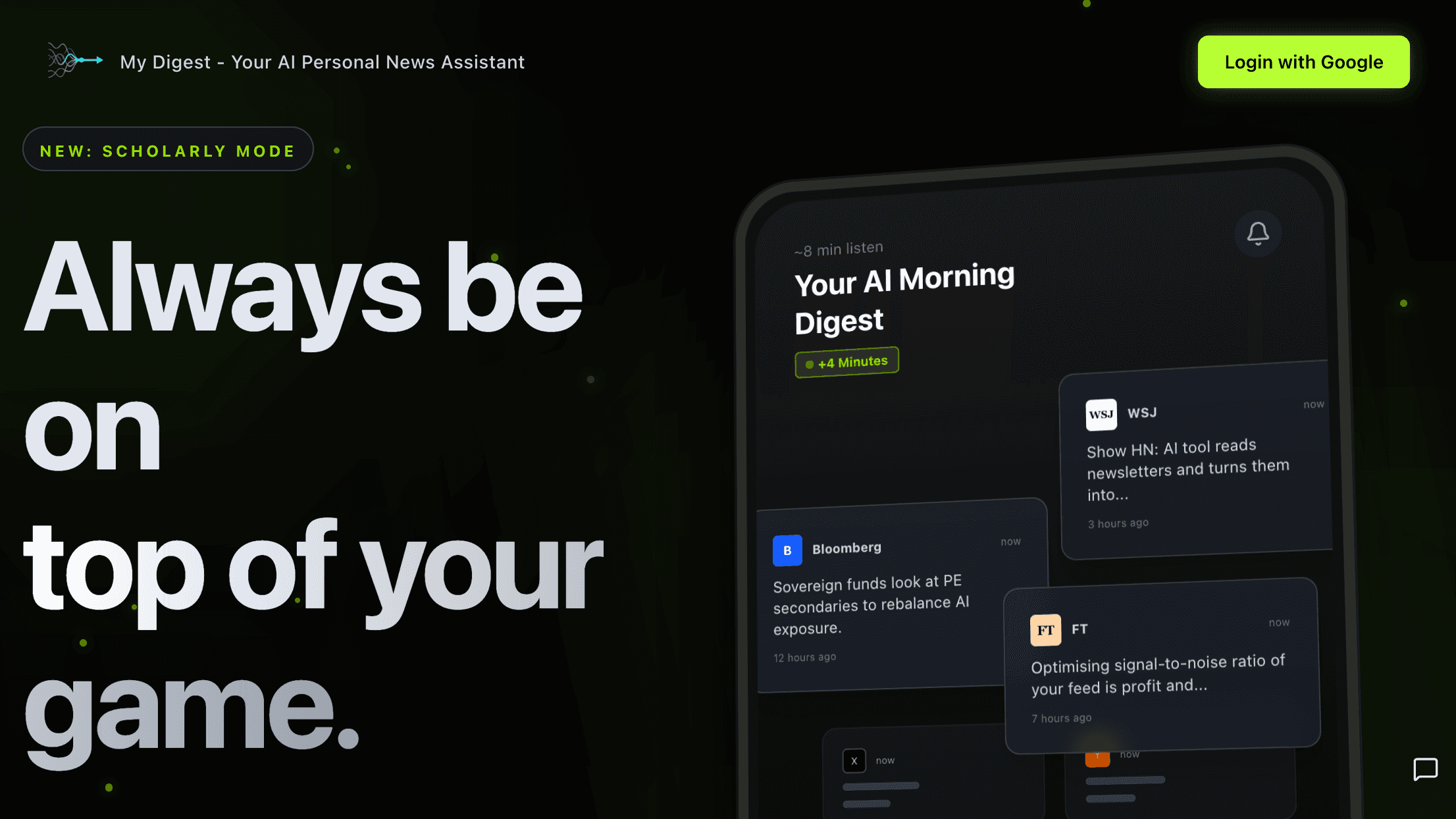
MyDigest is an AI-powered personalized audio news platform that scans 1,000+ sources — including Bloomberg, WSJ, and X — and delivers daily briefings tailored to your professional role. Built for busy professionals who want signal, not noise.
Professionals are drowning in information but starving for insight. Existing tools like Bloomberg are expensive and generic, while social feeds like X and Reddit are noisy and time-consuming. There's no lightweight, personalized way for busy professionals — especially investors and founders — to stay on top of what actually matters to their role, every morning, in minutes.
Primary: Asset managers, individual investors, and finance professionals who need to stay informed on market news but don't have time to curate their own feed. Secondary: Founders and startup operators who want to track industry signals, funding rounds, and emerging tech trends without doomscrolling. Common trait: LinkedIn-active professionals with a defined role/industry who value signal-to-noise ratio over raw volume.
1. LinkedIn as the personalization layer — Instead of forcing users to manually select topics, we infer professional context from their LinkedIn headline, skills, and industry. This reduced onboarding friction to under 90 seconds. 2. Audio-first format — Chose a 4–8 minute audio digest over a text feed to fit into commute/morning routines and differentiate from existing read-heavy aggregators. 3. Scholarly Mode & source diversity — Curated across WSJ, Bloomberg, HackerNews, TechCrunch, Reddit, and X to serve both finance-heavy and tech-heavy users with one product.
1. Personalization beats curation — Users responded more positively to content that felt "made for me" (via LinkedIn context) than curated editorial feeds. 2. Audio is a differentiator, but text still wins retention — Heavy audio users loved it, but most users still gravitated toward skimming text summaries first before committing to a listen. 3. Morning timing is critical — Delivery at 7am ET drove significantly better open/engagement rates than midday or evening digests.